There’s a chart I keep coming back to.
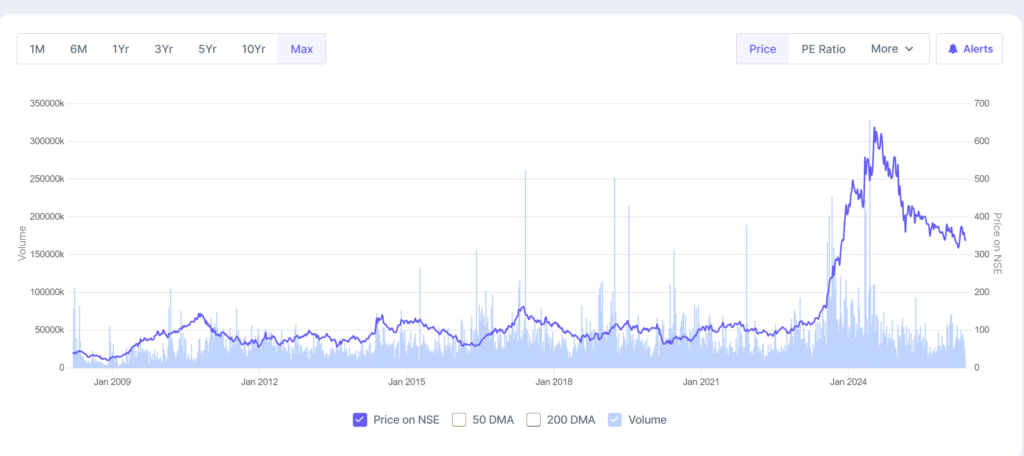
REC Limited. Maximum view. 2008 to today.
For fifteen years — 2008 to 2023 — REC traded in a quiet range. ₹80 to ₹180. Boring. Ignored. Exactly the kind of stock this framework was built for.
Then something changed.
The PSU rerating wave hit in 2023-24. Government capex narratives. Power sector enthusiasm. Institutional buying. REC went from ₹150 to ₹600 in roughly eighteen months. Volumes exploded. Headlines multiplied. Everyone had a price target.
And then it came back down.
It’s at ₹336 today. I own it. I entered at ₹337 on 21 May 2026.
That’s the honest starting point for this post.
REC Limited — Maximum view. Fifteen years of range-bound trading, followed by the 2023-24 PSU rerating wave. Source Screener.in on May21 2026
What Most Investors Did
When REC was at ₹550-600, it felt like a momentum trade with fundamental backing. Government owned. Power sector. India’s infrastructure story. Dividend paying.
All true. All still true today.
But the price reflected something else entirely — narrative certainty, crowded enthusiasm, and FOMO disguised as conviction.
The retail investor who bought at ₹580 is now sitting on a 40%+ loss. Not because the business broke. Because the entry was emotionally dangerous.
What the NoTradeZone Framework Would Have Done
The three entry conditions for a Mode 1 PSU setup are:
- 20-30% fall from recent high
- Stock moving sideways
- Volumes drying up
At ₹600, none of these were present.
The move was vertical. Volumes were exploding. Narrative certainty was extreme. PSU enthusiasm was crowded. Every financial channel had a REC recommendation.
That phase violates every NoTradeZone condition. No calm stabilisation. No boredom. No emotional exhaustion. No compression. Too much attention.
Under NoTradeZone conditions, this usually becomes a wait-and-watch phase. Not because the fall was predicted. Because the entry conditions simply weren’t present.
Would NoTradeZone Have Bought at ₹450?
Honestly — maybe.
If the fall from ₹600 had produced visible stabilisation. If volumes had calmed. If the narrative had cooled. If the emotional selling had normalised.
That’s not a perfect entry. REC at ₹450 is still elevated on a 10-year chart. But it’s emotionally safer than ₹600. The framework would have required patience — waiting for structure, not chasing price.
That’s one of the hardest things psychologically about this approach. Good frameworks often enter late. They miss the euphoric upside entirely. They wait for boredom while everyone else is celebrating.
The Honest Admission About My Current Position
I entered REC at ₹337 on 21 May 2026.
That’s roughly 22% off the ₹429 recent high. Volumes have been quieter. The range has been compressing. Book value is ₹323. Dividend yield is 5.38%.
The three conditions were closer to met than they were at ₹600. That’s why I entered.
But I’m not going to pretend the 10-year chart looks cheap. On a full historical view, ₹337 is still well above where REC spent most of its existence. The PSU rerating created a new range. Whether that range holds or fully unwinds is genuinely unknown.
What I can say is this — the entry is more defensible than ₹600. The dividend provides a cushion while waiting. The framework was applied, not abandoned.
Whether that’s enough will only be clear later. That’s the nature of documenting decisions in real time.
NoTradeZone Is a Behavioral Filter, Not a Prediction Engine
This is the most important thing to understand about this framework.
It doesn’t predict tops. It doesn’t catch bottoms. It will miss large upside during euphoric phases. It enters late — into calm structure rather than early into emotional chaos.
What it attempts to do is narrower and more honest:
- Avoid FOMO buying
- Avoid emotionally crowded entries
- Avoid late-cycle narrative chasing
- Enter after structure improves, not before
The PSU rerating wave of 2023-24 created some of the most emotionally crowded retail setups in recent years. Stocks that traded at ₹100 for a decade suddenly had price targets of ₹800. The narrative was compelling. The momentum was real. The FOMO was overwhelming.
My approach during phases like this is usually to wait. Not because of superior analysis. But because when a stock is moving vertically with exploding volumes and extreme narrative certainty, the entry conditions simply aren’t met.
Sit out. Wait. Let the cycle exhaust itself.
The Closing Thought
A reader asked me recently what the point of this framework is if it misses big moves.
The honest answer is: that’s not the right question.
The right question is — what’s the cost of the entries it prevents?
The investor who bought REC at ₹600 didn’t just lose 40%. They lost the confidence to hold through the recovery. They lost the capital that could have been deployed at better prices. They lost the psychological stability that disciplined investing requires.
But I want to be honest about something.
I entered REC at ₹337. That’s not cheap on a 10-year chart. The PSU rerating may not fully unwind — or it might unwind further. I don’t know. What I do know is that the entry felt less emotionally crowded than ₹600 did. The dividend provides some cushion. The conditions were closer to met.
Whether that’s enough — I’ll find out.
The goal here is not to buy the lowest price. It’s to avoid the entry I’d regret most — the one made during maximum excitement, when everyone else is buying and it feels obvious.
That’s what I’m trying to do. Whether I’m succeeding is a question only time and the timeline updates will answer.
Related Reading
About the Author
Jonathan — Endurance athlete. Investor by discipline. I document real trades in real time — entry prices, thesis, risks and honest updates. No tips. No calls. Just disciplined thinking, publicly archived.
All views expressed are personal. This is not investment advice. Please consult a SEBI registered advisor before making investment decisions.